Is a Blue Chinese Wisteria Tree Really a Tree or a Vine?
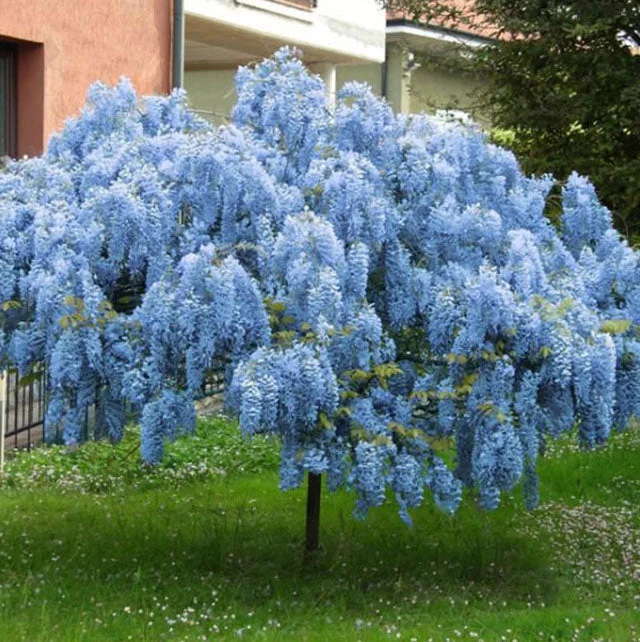
Stand under a Blue Chinese Wisteria Tree in full spring bloom and the first thing you notice is the scent, faint and sweet, drifting down from racemes that hang 6 to 12 inches long and sway under their own weight. The second thing is a quieter realization. The plant hanging over your head is not behaving like a tree at all.
Chinese wisteria is a climbing vine, and the tree is a shape we give it. Forget that and the plant pays for it. A trunk left without support leans, the head never fills out, and whippy shoots start winding around the stake, the trunk and anything else within reach.
In this article, we'll go through how a twining stem climbs, how a nursery builds a trunk from it, what the roots are doing underground, and how to tell whether your plant is holding its shape.
How a Twining Stem Actually Climbs
Everything we do to a wisteria tree makes sense once you see how the stem behaves when nobody is directing it. This section covers the vine underneath the form.
A Vine With No Hands
NC State Extension describes Chinese wisteria as a deciduous, climbing, woody vine in the bean family, native to China. It has no tendrils and no sticky pads. It climbs by twining, and the direction never changes: the stem winds counterclockwise around whatever it finds.
Picture the tip of a young shoot in late spring. It stretches out and sweeps slowly through the air, and the moment it touches a post, a wire or a neighbor's branch, it begins to wrap. As the stem thickens it squeezes harder, which is why wisteria can strangle a support that looks sturdy.
How Far and How Fast It Reaches
The growth is rapid, and the climbing form can reach up to 40 feet, often covering trees and shrubs. We won't give you a growth figure per year, because the sources don't, but one summer shoot crossing a path will show you the speed.
The foliage tells the same story. The leaves are alternate and pinnately compound, with 7 to 13 leaflets each 2 to 4 inches long, an arrangement made to blanket a support. That is the plant you are buying when you buy the tree. You will sometimes hear that a wisteria tree is a dwarf. We disagree: it is the same vine with its ambitions edited by a pair of pruners.
Where the Blue Chinese Wisteria Tree Comes From
Nobody finds a wisteria growing as a tree in the wild. A nursery builds the form over several seasons, and knowing how helps you judge any plant you are offered.
Training One Stem Upward
You can train wisteria as a free-standing standard, and doing so restricts its vigor and lets you grow it in a border or container. The method is simple. Pick one strong shoot, tie it to a stake, strip off every competing stem, and keep stripping while the leader climbs.
Once the stem reaches the height we want, we let the top branch. Those branches become the head, the part that carries the flowers. Every season the side growth on the trunk is removed so that the plant's energy goes into thickness below and branching above.
Where Grafting Fits
Seed-raised wisteria can take up to 20 years to flower. That is why serious growers do not rely on seedlings. Where a plant is grafted, a piece of a known flowering plant is joined to a root system, and the tree is trained from that. Where it is grown from a cutting, the plant simply carries the parent's habits.
Customers usually ask us whether the tree is a different species. It isn't. A trained Blue Chinese is Wisteria sinensis with a lifted head, so the scent, the blue-violet flowers and the twining all come with it. The years it takes to bloom depend on the plant's age and the stock it came from.
Inside the Trunk of a Blue Chinese Wisteria Tree
A trunk on a vine sounds like a contradiction, but the wood explains it. Here is what the trunk is and why it can hold a canopy.
Wood Laid Down Year by Year
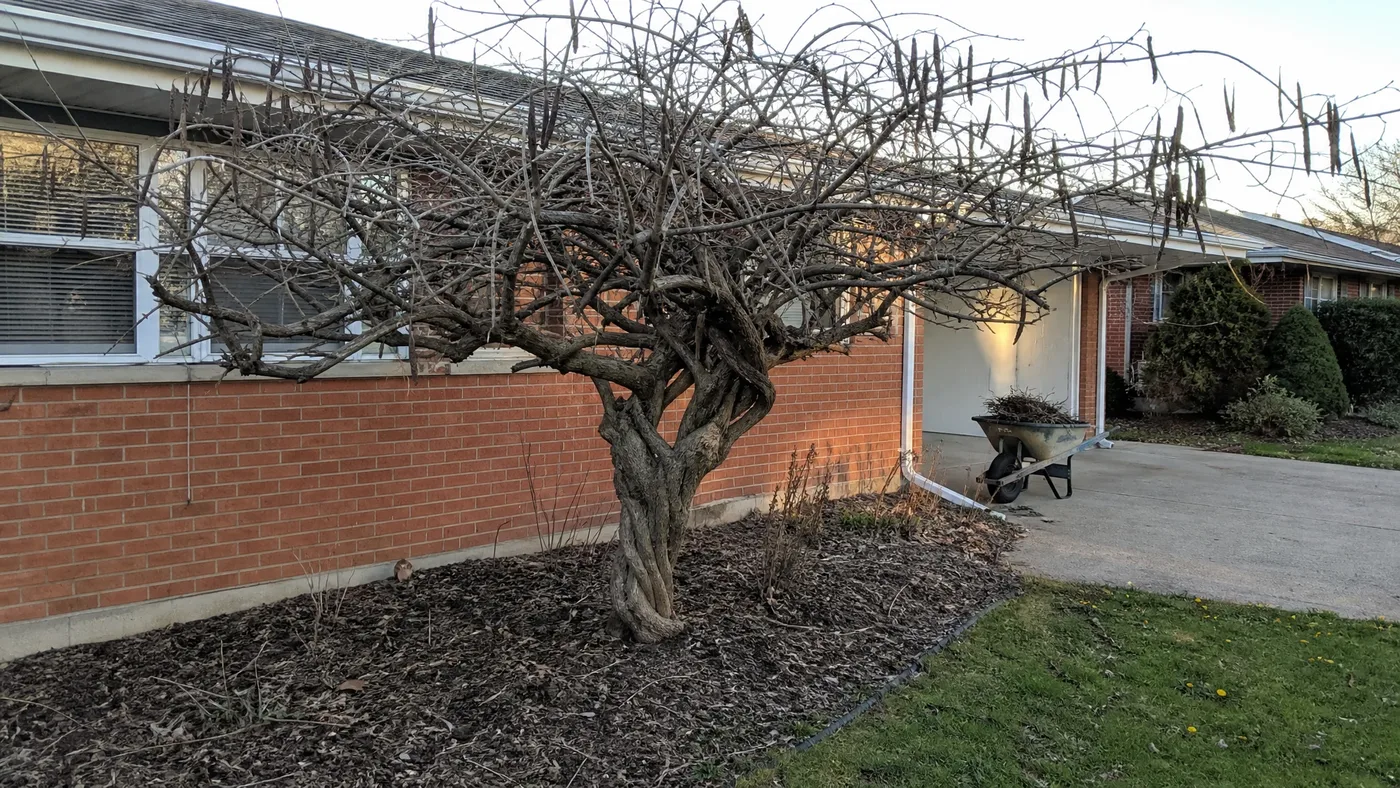
Stems become twisted, trunk-like, and massive over time. A wisteria stem is woody, so it thickens each year the way a tree trunk does. Left on a pergola it gets thick and ridged, with the twist of a rope. On a standard we keep it straight and let it widen until it can bear the head.
The wood is tough, but the plant's design is still a climber's. A vine stem is built to be long and flexible, and to lean on something. A young trunk therefore needs its stake until it can stand under a full head of wet leaves and blooms. We tell customers to loosen ties as the trunk widens, never to remove the support in one move.
Why the Canopy Holds
The head is a framework of short, woody branches around the top of the trunk. Short branches are the point. A vine left alone sends out long, floppy shoots, but a head pruned hard each year stays compact and stiff enough to carry the blooms. Shorten the excess whippy growth in July and August to five to six leaves, about 1 foot.
That summer cut matters more on a tree than on a wall plant, because the head has nothing to lean on. Our guide to pruning for bigger blooms covers the timing in full. Skip the cut and the head grows heavy and ragged, and the trunk pays for it.
Why Roots Don't Care What You Call It
Below the soil, a standard and a pergola vine are the same plant. The roots belong to a species that evolved to feed a climber of many feet, and that decides where you can plant it.
A Vine's Root System Under a Small Head
Nothing in our sources gives a root spread, so we won't invent one. What we can say is that a tree-form wisteria keeps a vigorous vine's root system under its tidy head. Training changes what you see above ground. Pruning the canopy does not shrink the roots, so give the plant room as if it were the full vine, and check setbacks for pipes and foundations with your local extension service.
What the Roots Want
Illinois Extension says this vine needs a deep, moist, well drained soil. The same listing gives full sun and a mature height of 20 to 25 feet for the species, and the plant is hardy in zones 5a through 8b. Our size guide explains how the tree form compares.
In our rows, the plants that settle fastest are the ones given loose, deep soil and a spot where roots can run. Plant a standard in a thin bed over rubble and it sulks, however handsome the head. If you are using a container, the pot only limits the roots, so expect to manage water closely.
Is Your Blue Chinese Wisteria Tree Staying a Tree?
A trained standard reverts when the vine's habits get ahead of your pruning. The signs are easy to read if you know where to look.
Signs of a Plant Slipping Back
This table sets out the signs we check for, what each one means and what we do about it.
| What you see | What it means | What to do |
|---|---|---|
| Long, thin shoots coiling around the trunk | The vine is twining on its own stem | Cut them off at the base and unwind any that have wrapped |
| Shoots rising from the ground or below the union | Growth from the roots or rootstock, not the trained head | Remove them cleanly as close to the source as you can |
| A leader that bends and sprawls | The head is heavier than the trunk can carry | Shorten the head and keep the stake and ties in place |
| Stems touching the soil | They can root and form a new plant | Prune them back before they reach the ground |
What Reversion Means
It does not mean the plant is failing. It means the vine is being a vine, and your job is to keep editing. A tree form is a commitment to pruning every year for the life of the plant, not a one-time purchase.
It also matters beyond your fence. Oregon State's landscape plant database notes that Chinese wisteria is reported to have invaded natural habitats across many eastern and southern states. A well-kept standard is the opposite of that: a plant with its shoots controlled.
What to Ask Before You Buy a Blue Chinese Wisteria Tree
Any plant sold as a wisteria tree should survive a few direct questions. These are the ones we would ask if we were standing in the buyer's shoes.
Questions for the Seller
Run through these before you pay. A good seller answers them without hesitating.
- Is the plant grafted, or grown from a cutting, and what was it propagated from?
- Has it been trained on a single trunk from the start, and for how many seasons?
- Is the trunk straight and firm where it meets the stake, with no kinks or soft spots?
- Does the head have a clear framework of branches, not one tangle of long shoots?
- Is the plant from flowering stock? Flowers may not appear until the 2nd or 3rd year after planting, sometimes much longer.
Our buying guide covers sizes and what a healthy plant looks like on arrival.
Which One We Would Choose
If you have a courtyard, a border or a large pot, choose the tree. It keeps the scent and the color where you can reach them, and you will prune a trunk with a head rather than a hundred feet of stem. If you have a strong pergola and room to spare, the vine is the plant we would pick, because it gives the full waterfall effect. Just be honest about how much pruning you want to do.
Both Things at Once
A Blue Chinese Wisteria Tree is a climbing vine that has been taught to stand, and it stays both for life. The twining instinct, the vigorous roots and the appetite for height are all still there under the sculpted head. That is not a flaw to hide. It is what gives the plant its character.
Blue Chinese Wisteria Tree
Nursery-grown Blue Chinese Wisteria Tree in sizes from Quart, shipped to your door.
From $49.49
Shop Now →Picture it in May: a stout trunk, a rounded crown, and blue-violet racemes hanging in a soft curtain, with bees working the flowers and a sweet scent in the air. Choose it with open eyes and it will reward you every spring. Our growers watch these plants through the year, from the first leaf buds to the July shoot cuts and the winter ties, so we know what each season asks of them.