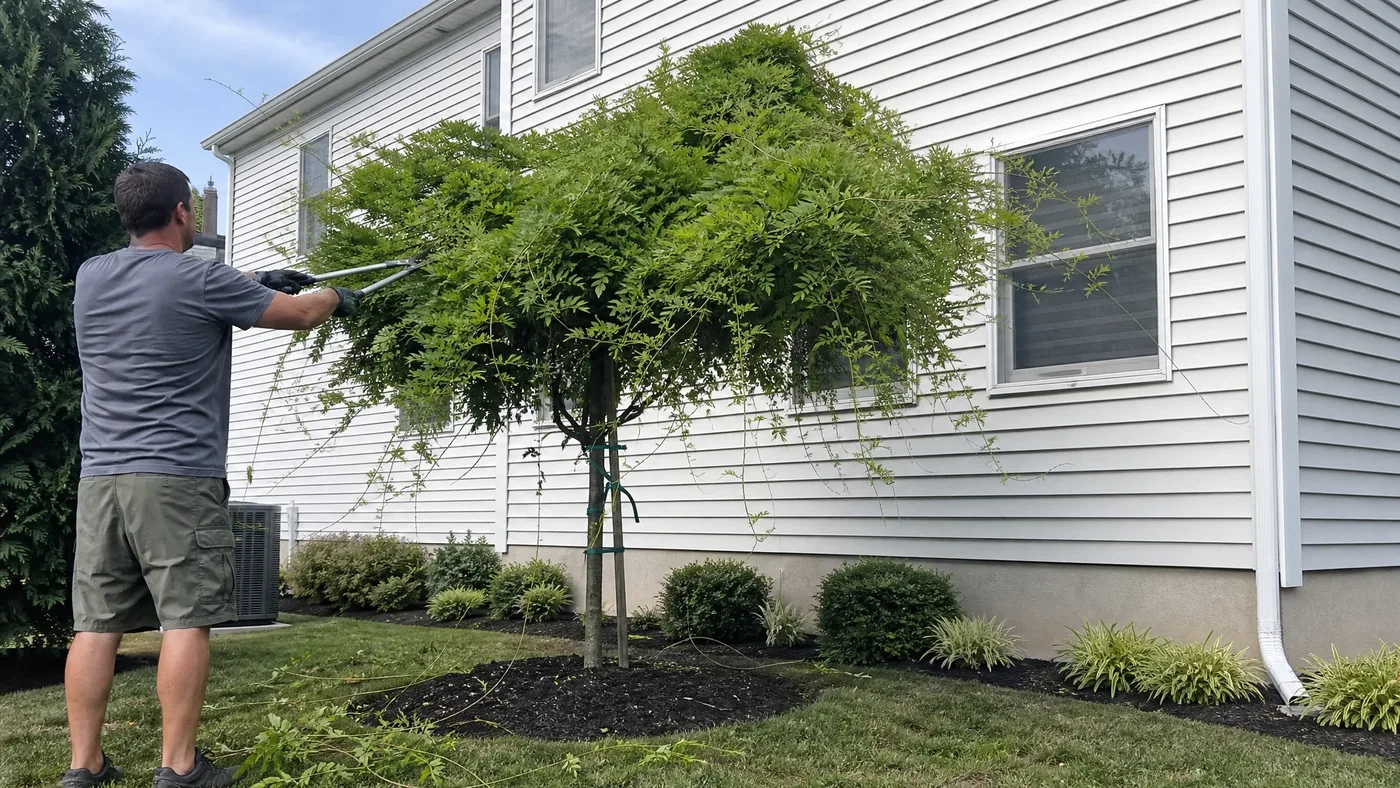
Is Blue Chinese Wisteria Invasive? Roots, Spread and Control
A customer wrote us last spring: "Will my wisteria take over the yard, and is it going to hurt my neighbor's maple?" The honest answer is that it can do both. NC State Extension calls the species rapid growing and an invasive weed, and a vine left alone will climb, root and seed into places you never planned for.
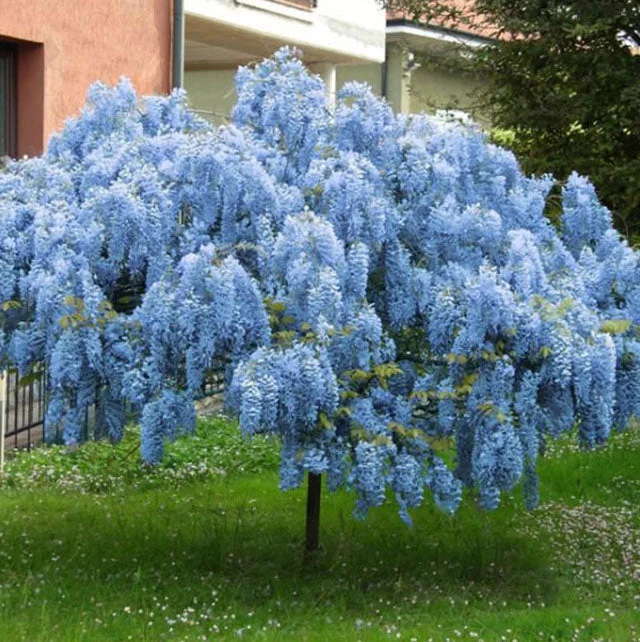
Done badly, control costs you years and a damaged tree. Done right, you keep the bloom and lose the risk. We checked each common belief about this plant against extension and forestry sources, and where they give no number, we say so.
Read on for what the vine does to host trees, what the roots do underground, how much the seed pods matter, why cutting back fails, whether grafted plants are safer, where herbicide fits, and the removal and containment steps in order.
Does a Blue Chinese Wisteria Tree Strangle Other Trees?
Yes, when the vine is allowed to reach one. The belief that a big tree is too tough to be harmed is the part that fails.
What the Stems Do to a Trunk
Wisteria twines around whatever it climbs. Alabama Extension reports that wisteria climbs trees to 70 feet or more and girdles even mature hardwoods.
The mechanism is simple. A twining stem thickens every year, and the coil tightens as it does. Eventually it presses on the bark and the tissue beneath, which carries water and sugars. We give no per-year damage figure because the sources give none.
Shade Does the Second Damage
Girdling is not the only harm. The USDA Forest Service notes that dense wisteria infestations strangle or shade out existing vegetation and displace native species. A canopy of leaves over a host tree cuts the light the host needs.
The foliage is pinnately compound, with 7 to 13 leaflets of 2 to 4 inches each, so a mature vine builds a thick, layered cover. That is lovely on a pergola and a burden on a branch.
What We Tell Customers
One of the most common questions we get is whether it is safe near a mature oak or maple. It is not. Give the plant its own support: a pergola, a post or a wall frame. Keep every stem off living trees.
Check the support each year for shoots reaching toward a neighbor. Our care guide covers the safety side briefly, and the problems guide shows how to stop vines tightening on a trunk you own.
Roots Run Deeper Than the Blue Chinese Wisteria Tree Shows
The trunk and vines you see are not the whole plant. Most of the control problem sits below the soil line and along the ground.
Runners Matter More Than Seed
The USDA Forest Service Fire Effects database says that although seeds form in favorable conditions, vegetative growth from rooting of vines and stolons is the main method of wisteria spread. A stem that touches soil can root. A new plant then stands apart from the first one.
The sources give no root depth and no runner distance in feet. Ask your local extension service what is typical in your soil. Do not trust anyone who quotes you a precise figure without a source.
Why Good Soil Makes It Worse
Illinois Extension says this vine needs a deep, moist, well drained soil. That describes most garden beds, which is why it thrives in them. Alabama Extension adds that it adapts to both wet and dry sites.
The species reaches 10 to 20 feet in height and 4 to 30 feet in width, so the plant above ground is already large. What lies below supports all of it, and that stored energy is what makes cutting so ineffective, as the fourth section shows.
Survey Your Yard Before You Act
Walk the whole perimeter of the plant and well past it. Do this in summer, when leaves make shoots easy to spot.
Look for stems lying on the ground that have rooted at a node. Check for shoots coming up from soil away from the main stem. Follow any vine that disappears into a neighbor's hedge or tree. Mark each find with a flag so you can return and treat it.
Seed Pods Make Every Blue Chinese Wisteria Tree a Spreader
Pods are often waved off as ornament. The truth sits between that and the alarm.
What the Sources Say About Dispersal
Wisteria pods and seeds are large and heavy, which limits dispersal by birds and mammals. Heavy seeds do not travel far. No source we use gives a seed count per pod, a throw distance or a germination rate, so we will not quote any.
Our position is that pods are a secondary risk, but a free one to remove. Seedlings, when they appear, tend to turn up near the parent or where soil or debris moved. That is a reason to check the ground below the plant each year.
How to Handle Pods Safely
Remove pods before they dry and split, or at the latest in winter after leaf drop. Wear gloves. The toxic principle is lectin and wisterin glycoside, and every part of the plant is poisonous, though the severity is low. Our toxicity guide covers the household side.
Bag the pods and throw them away. Do not compost them or leave them on open soil.
If you grow the Japanese type, the habits differ. Our comparison guide sets them side by side.
Cutting It to the Ground Kills a Blue Chinese Wisteria Tree
It does not. Cutting removes top growth and leaves the root system intact and ready to answer.
Stumps Resprout
Wisteria can sprout numerous times after cutting, so treatment must be repeated until root stores are exhausted. Each cut forces the plant to spend stored reserves on new shoots. It dies only when those reserves run out.
The sources give no count of cuts, so plan for many passes over several seasons.
Severed Runners Root Again
A stem cut from the parent can root where it lies if it touches moist soil. Lift cut vines off the ground and bag them. Never leave a pile at the edge of the bed.
Pruning Is Not Control
Annual pruning for flowers is a different job with a different goal. The pruning guide explains how to shape a plant you keep. In our rows, a pruned plant comes back vigorously, which is the point of pruning and the problem of using it for removal.
Grafted Plants Are Not Safer Than Seedlings
A grafted plant is joined to a rootstock, while a seedling grows from seed. Many buyers assume the first is tamer.
We found no source that compares the two. What the sources do show is that Chinese wisteria spreads by rooting vines and stolons, and a graft changes none of that. Treat both as the same species with the same habits.
Where Rootstock Suckers Come From
On a grafted plant, shoots that emerge below the graft union belong to the rootstock, not the top. They can look different from the growth above. Cut them off flush with the root or trunk where they start, and do it early, before they thicken.
Check the base each spring. Our buying guide explains what to inspect at purchase. We grow and sell these plants, so ask us how a given plant was propagated and we will tell you.
Herbicide Is Never the First Step
Spraying feels fast, but it works best on a prepared plant. Cut first, then treat the cut.
Why We Favor Cut Stump
Foliar spraying a vine in a tree canopy risks the host tree and the plants around it. The sources we use focus on cut-stump and basal bark methods instead. Alabama Extension says they work any time of year except during spring sap flow.
The table below sets out what the sources support.
| Method | Timing | What the sources say |
|---|---|---|
| Cut stump | Any time except spring sap flow | Glyphosate or triclopyr applied 2 inches above ground was effective (finding reported for Japanese wisteria) |
| Basal bark | Any time except spring sap flow | Works on the stems, per Alabama Extension |
| Foliar spray | Check the label and local extension | Our sources give no timing or rate |
Limits You Should Respect
The 2-inch result is for Japanese wisteria, not Chinese. Rates and mixing come from the product label, and local rules may restrict use near water. Ask your extension service before you buy anything.
Even a correct treatment may need repeating. The plant resprouts, and one application does not guarantee the root system is gone.
Removing an Established Blue Chinese Wisteria Tree Step by Step
Follow this order. Skipping the early steps costs you later.
- Cut the climbing stems. Cut each stem at the base and again higher up. Leave vines in a host tree to die back rather than pulling them down and tearing bark.
- Treat the stumps at once. Apply your chosen product to each fresh cut, with the stump cut about 2 inches above ground. Avoid spring sap flow.
- Dig what you can reach. Follow runners back to the source and lift them. Bag every piece, since cut vine can root on soil.
- Remove pods and cuttings. Bag them for the trash. Do not compost.
- Return and repeat. Cut or treat each flush of regrowth the moment it shows.
Monitor Every Growing Season
Walk the site each season, in the same spots you flagged. Treat anything green. Treatment must be repeated until root stores are exhausted, and nothing tells you in advance when that happens.
Keep a short log of dates and locations. It shows whether regrowth is thinning, and it stops you from declaring victory after one quiet summer.
Containing the Plant You Decide to Keep
If you keep one, set limits and hold them. These are the ones we use.
- Give it a freestanding support away from trees, fences and neighbors' property.
- Remove every pod each year before it splits.
- Cut any stem touching the ground before it roots.
- Edge the bed with a deep, solid barrier and check the line each summer for shoots beyond it.
- Prune on a set schedule, as in our pruning guide, so growth never gets ahead of you.
Size sets your limits too. Illinois Extension gives 20 to 25 feet for height, and NC State gives a spread of 4 to 30 feet. Allow for the top of that range when you place the support.
Plan on Seasons With Blue Chinese Wisteria
The vine girdles trees, spreads mainly by runners, resprouts after every cut and does not care whether it was grafted. Pods are a smaller risk, and herbicide does not work only on cut stumps, since basal bark sprays and foliar sprays (most efficient late summer to early fall) are also effective. Monitor each growing season until one full season passes with no regrowth. Control is a routine, not a one-time job.
Blue Chinese Wisteria Tree
Nursery-grown Blue Chinese Wisteria Tree in sizes from Quart, shipped to your door.
From $49.49
Shop Now →On our farms, we grow this plant in full sun and deep, well-drained soil, on supports we manage and prune every year. We are a small business, and we would rather you keep one under control than lose a tree to it.