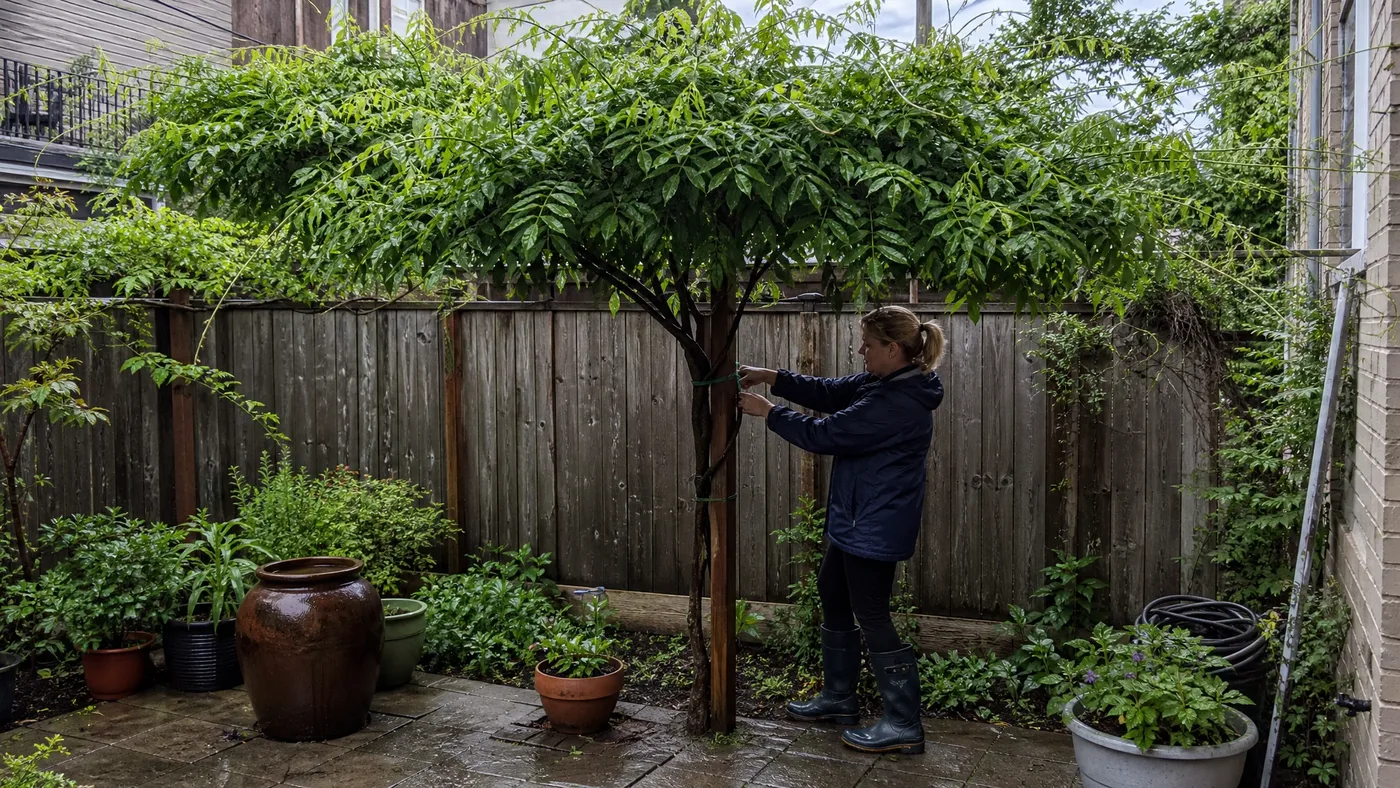
Staking and Support for Your Blue Chinese Wisteria Tree
"My tree leaned after last night's wind. Is it ruined?" We hear some version of that call every year, usually from someone standing in the yard with a very worried face. Take a breath. A leaning standard is almost always a support problem rather than a plant problem, and support problems are fixable.
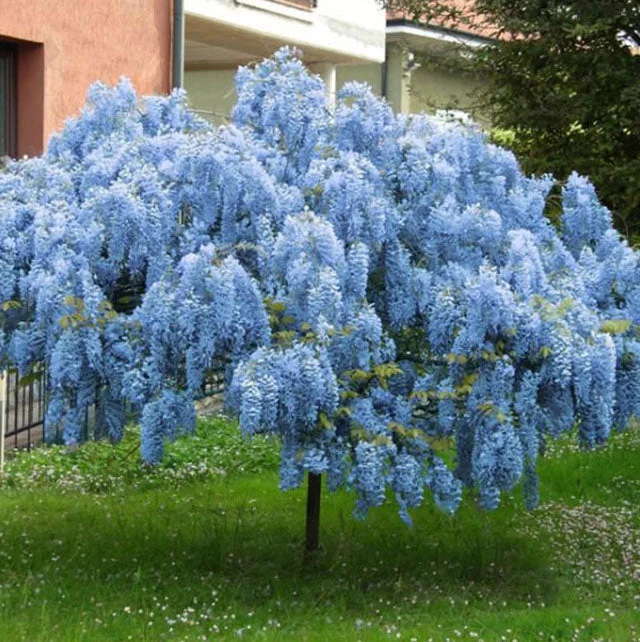
A Blue Chinese Wisteria Tree is one trunk holding up a head that gets wider and heavier every year, and it was never meant to do that alone. A vine can lean on a wall, but a standard has to stand by itself. With the right support, the head hangs its blue-violet clusters evenly in May instead of lurching to one side.
We'll walk you through one example tree, starting with the choice between a stake, a frame and an umbrella, then sizing and setting the post, and finally adjusting it all as the canopy fills out.
Meet Our Example Blue Chinese Wisteria Tree
Every number in this guide belongs to one tree, so you can borrow what fits yours and adjust the rest.
The Tree and Its Corner
Picture a six-year-old standard with a clear trunk about four feet tall and a spreading head on top. It stands in an open corner of a lawn in full sun, which means six or more hours of direct light a day.
The soil is deep, moist and well drained, the kind Illinois Extension says this plant needs. The only trouble is the wind. Gusts funnel across the lawn from one side, and the tree has started to lean away from them.
The Stake It Has Outgrown
When it was planted, it went in beside the slim stake that suits a young single-stemmed plant, which was exactly the right start. Six years on, the trunk has thickened and the head has widened. The old stake is now just along for the ride, with ties that have worn and a base that has gone soft.
The tree flowers well. Last May it carried clusters 6 to 12 inches long of mildly fragrant blue-violet flowers, and all of that bloom is weight held out on one side of a single pole. That is the problem we are solving. If you are still at the planting stage, our planting guide covers the first stake.
Why the Trunk of a Blue Chinese Wisteria Tree Needs Help
The short version is that your tree is top-heavy by design, and a trunk alone is a poor way to carry that.
Wisteria sinensis is a rampant climber by nature. It grows rapidly, and Utah State Extension warns that its weight and twining stems can destroy all but the strongest structures. A standard takes that same energy and asks one grafted trunk to carry it.
Training the plant as a standard does restrict its vigor, which is why the form works in a border or a large container at all. But a restricted wisteria is still a wisteria, and the head keeps thickening every year.
Then there is wind. In summer the head carries pinnate leaves with 7 to 13 leaflets each, so it works like a sail.
Add the flower clusters in May, or a heavy rain that leaves everything soaked, and the head pushes on the top of the trunk like a long lever. The base of the trunk twists in the soil, and over a few seasons the whole tree tilts.
In our rows, a standard left without support almost always leans toward the side its head grew heaviest. A lean isn't a break, though. The trunk is usually fine, and a firm post with soft ties brings most trees back to upright.
Choosing Between a Stake, a Frame and an Umbrella
There are three common ways to hold up a standard, and each suits a different stage of the tree's life.
The Single Stake
This is the simplest option and the one most standards start with.
A stout upright post sits right beside the trunk. Start with a young single-stemmed plant and a stout support of 4 to 5 feet beside it, and train the stem straight up the support, since that is usually stronger than twining. A stake is cheap, nearly invisible and fixes trunk lean, but it does nothing for the head itself.
The Frame
A frame adds a ring or cage at the top of the post to cradle the main branches.
It suits a head that has grown heavy enough to sag at the ends. It is more visible and takes more building than a stake, so we would not add one until the tree asks for it.
The Umbrella
An umbrella frame has arms that radiate from the top of a central post, and the branches are tied out along them so the blooms hang evenly.
It gives the tidiest, most formal shape and the most support, but it costs the most and takes the most work. It is best for a mature head that is already wide.
Which Support Fits Our Tree
The example tree needs a single stout post now. Its problem is a leaning trunk, not a sagging head, and a post fixes that. The same post can carry a frame or umbrella later, so nothing is wasted.
You may also have searched for a trellis. Skip it, because a flat trellis suits a vine and a standard's round head has nothing to climb.
Sizing the Post for a Blue Chinese Wisteria Tree
Here is what we chose for the example tree and the reasoning behind each choice.
Diameter. Utah State Extension recommends 6x6 or larger wood posts or steel beams for arbors that carry a whole vine. Our tree has one trunk, so we go a size under that, but never spindly. Pick a post clearly thicker than the trunk, because a thin one flexes at the ground and a wisteria's head will find that flex.
Height. The post should reach to the base of the head, here about four feet above the soil, matching the trunk. Pushing it higher into the branches invites rubbing. If you later add a ring or umbrella, extend the top then.
Burial depth. Bury it deep enough that it does not move when you push on it. Sandy soil needs more depth than clay, and cold regions need to account for frost, so ask your local extension service what depth suits your ground. We do not give a single number because one would be wrong somewhere.
Material and cost. Choose rot-resistant wood or galvanized steel. Bamboo and thin dowels are fine for the first year and then fail. Prices vary too much to quote, but a good post costs far less than replacing a tree that has leaned until it cracked.
In a pot, the same post goes in before you fill the container, and our container guide covers the rest.
Setting the Post and Tying the Trunk
Now the job itself, done on the example tree, one step at a time.
Dig and Set the Post
Do this on a day when the soil is damp but not soaked, so it digs easily and packs firm.
Stand on the side the wind comes from and mark a spot about a hand's width from the trunk. Probe with a spade or a metal rod first, because you want to miss the big roots. Dig the hole, set the post, and check it with a level on two faces.
Backfill in layers and tamp each one down. Give it a firm shove, and if it moves, dig it out and go deeper. Put the post on the windward side so the tree leans against it, not away from it.
Tie the Trunk With Soft Ties
Ties do the real holding, so choose them with care.
Use wide, soft ties such as rubber tree straps or strips of cloth. Never use wire or thin cord, which cut into bark as the trunk thickens. Place one tie just under the head and a second about halfway down the trunk.
Pass each in a figure eight with a small cushion between trunk and post so they never touch, and keep it snug, not tight. A trunk that can sway a little builds strength.
Customers usually ask us whether to pull a leaning tree upright right away. Don't. Straighten it in stages over a season, retying a little tighter at each check.
Adjusting the Support as the Canopy Fills Out
Over the next few seasons the post stays put, and the ties and the head are what change.
Loosen the Ties Each Year
The trunk gets thicker every year, so every tie eventually becomes too tight.
Wisteria is best pruned twice a year, in July and August and again in January and February. Use those visits to check the ties. If the bark looks pinched or puffy above or below one, loosen it or replace it now. Our pruning guide covers what to cut while you are up there.
Check for Rubbing and Twining
Look for shiny or scuffed patches where the trunk meets the post or the ties.
Add or replace cushioning wherever you see them. Wisteria also wants to twine, so shoots from the trunk will wrap the post and tie themselves into a trap. Cut them off or train them straight up, since vertical stems are stronger than twining ones.
In winter, once the leaves have gone, give the post a firm push. If it flexes more than last year, firm up the soil around it.
Know When to Add a Ring
Watch the edges of the head in late spring, when the clusters are at their heaviest.
If the outer branches sag when loaded with bloom, that is the sign to add a ring on the same post. If the head stays level, leave well enough alone.
What Year Ten Looks Like for This Blue Chinese Wisteria Tree
Fast forward four years and the example tree is ten. Here is what to expect and when to act.
The trunk is thick and firm, with a head that sits broad and balanced above the post. In May the long clusters hang evenly instead of dragging one side down. The species reaches 10 to 20 feet high as a vine, but a trained standard stays far more compact, as our guide to how big the tree gets explains.
The post is what ages. Probe the soil line with a screwdriver each year. If the wood is soft, replace it. Set a new post on the opposite side of the trunk, move the ties over, and only then pull the old one. The tree is never left unsupported while you swap.
Do not plan on removing the support altogether. A grafted trunk carrying a head that size needs it for life, and that is normal. A slight bend in the trunk from the early years is character, not damage.
A Steady Blue Chinese Wisteria Tree for the Long Run
A standard needs one stout post, soft ties that you check twice a year, and a willingness to loosen and replace things as the tree grows. If yours leaned early, or still leans a little, that is normal and fixable, and most trees we hear about come back to upright within a season or two.
Blue Chinese Wisteria Tree
Nursery-grown Blue Chinese Wisteria Tree in sizes from Quart, shipped to your door.
From $49.49
Shop Now →Every Blue Chinese we ship is potted and packed by our own growers on our own farms, so it arrives ready to plant and ready for the post you have just learned to set.