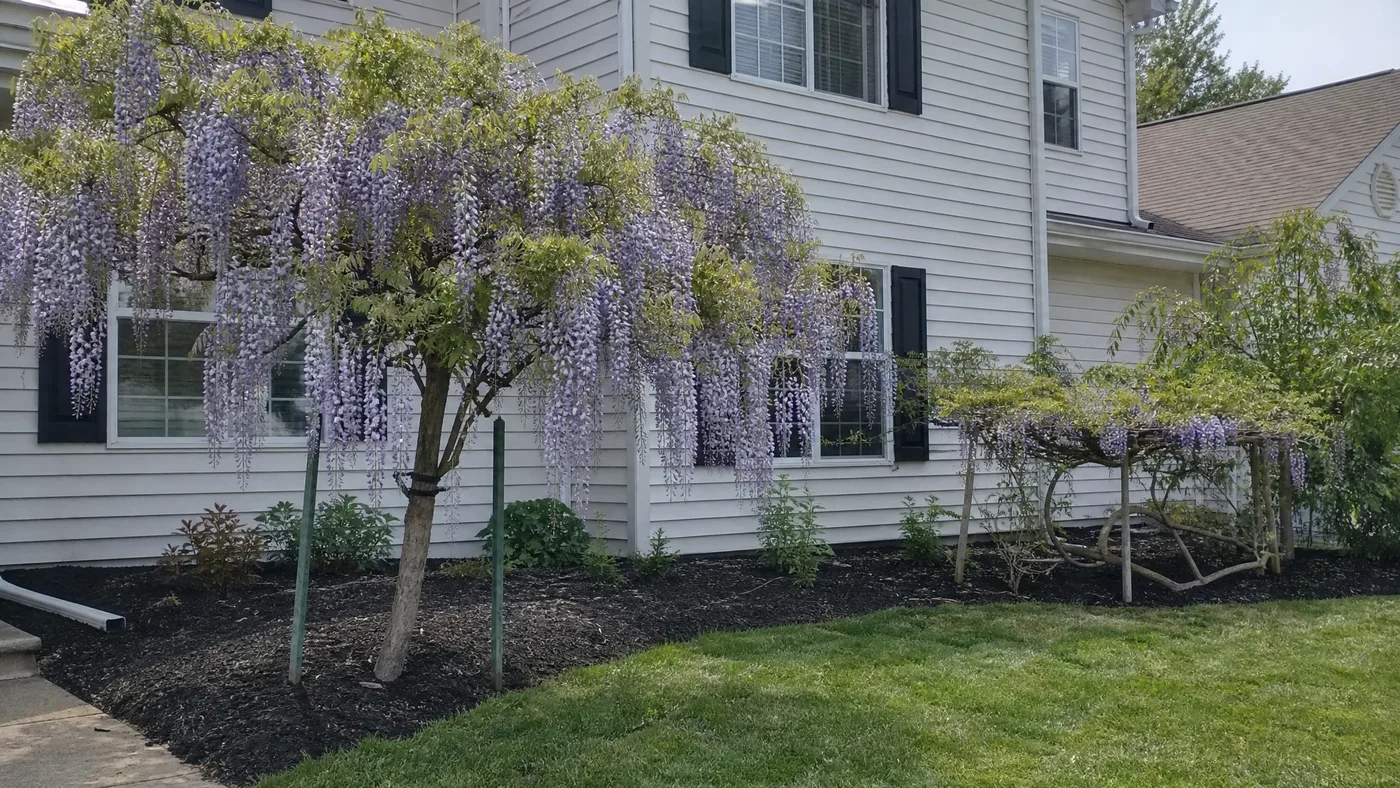
Blue Chinese Wisteria Tree vs American Wisteria
One May, years back, we sat on a porch where our old Chinese vine had already finished flowering, its spent clusters browning, while the native wisteria next door had barely leafed out and had not opened a single flower. That was the first time we understood that these two plants keep different calendars, and that the difference runs well past the bloom dates.
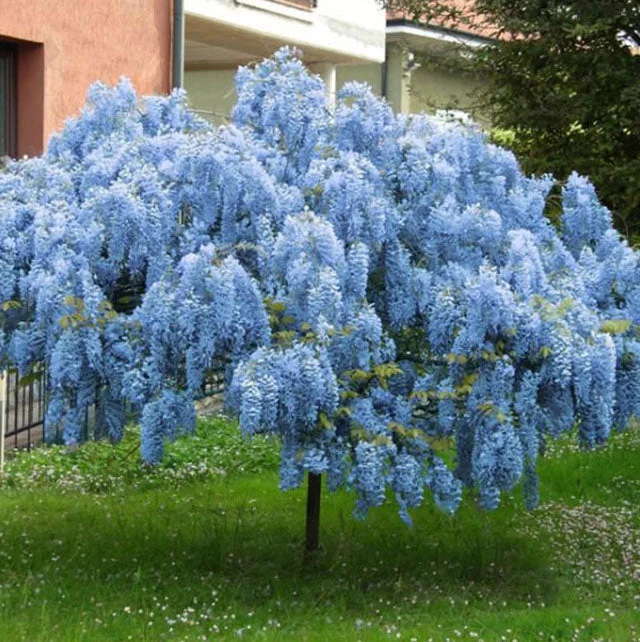
The Blue Chinese Wisteria Tree comes from Asia, and American wisteria (Wisteria frutescens) grows wild from Virginia to Illinois and south to Florida and Texas. That origin shapes how each one behaves in a yard, from its pruning demands to what it does beyond your fence. The wrong choice means either a summer with loppers in hand or a spring show you wished you had.
In this article, we'll go through invasive status, bloom timing, size, fragrance, hardiness and yearly upkeep, and then say plainly which we'd plant for which kind of yard.
Invasive Habits Where the Blue Chinese Wisteria Tree Stands Apart
We start here because this question settles the matter for a good many buyers before they read another word. The two plants could hardly differ more on it, and the extension sources are blunt.
What the Chinese Vine Does Outside the Garden
Wisteria sinensis is an invasive species in North Carolina, a rapid grower and an invasive weed. Oregon State's landscape plant database goes wider, noting that Chinese and Japanese wisteria and their hybrids are reported to have invaded natural habitats throughout many eastern and southern states.
None of that makes the plant unmanageable in a garden where someone prunes and watches it. It does mean you should ask your local extension service whether it is listed where you live before you plant. Our guide to roots, spread and control covers the practical side.
Why the Native Wins This Round
American wisteria is found in moist thickets, swampy woods, pond edges, stream borders and river banks across its native range. It is much less aggressive, requires less pruning and poses no risk to natural areas.
One of the most common questions we get is whether the native is the same plant, only safer, and on this point the answer is yes.
Verdict: American wisteria, clearly. The Blue Chinese is a plant that asks for a gardener's attention, and the native simply does not carry that worry.
Bloom Timing Against Leaf-Out
This is where the Blue Chinese earns its reputation, and it is the whole story of that porch in May. The order in which flowers and leaves arrive changes how the entire plant looks.
The split is easy to state: Asian wisterias bloom before the foliage opens, while North American ones bloom after the plant has leafed out.
The Blue Chinese follows the Asian pattern, with 6- to 12-inch racemes of blue-violet, pea-shaped flowers that open almost simultaneously on bare stems. It blooms in spring, and Illinois Extension lists its bloom as May.
American wisteria blooms in April and May, after its leaves emerge but before they have fully developed. The flowers sit among young green growth instead of against open wood.
On the Blue Chinese, the leaves come after the flowers: alternate and pinnately compound, with 7 to 13 leaflets, each 2 to 4 inches long and dark green above, per the Virginia Tech dendrology fact sheet.
Some people read a flowering, leafless vine as a plant that has not woken up yet. We think it is the best thing the Blue Chinese does, because the color arrives with nothing to compete with it. Our bloom time, color and duration guide goes further into the weeks themselves.
Verdict: the Blue Chinese gives the better show. The native is softer and prettier than most people expect, but it cannot match a whole plant dressed in flower with no leaves in the way.
Size at Year Fifteen, Measured in Ladders
By year fifteen, either plant has stopped being a young vine and become a structure, and the question is how far up and out it has gone. We measure it by the ladder you will need.
NC State gives the Blue Chinese as 10 to 20 feet high and 4 to 30 feet wide, and Illinois Extension puts it at 20 to 25 feet. That width range is the telling part. A spread that can sit anywhere between 4 and 30 feet means the plant takes the room you give it, and then the room you did not mean to give it.
American wisteria is a twining deciduous woody vine that grows to 40 feet or more. On paper that makes the native the taller plant, and anyone planning a small pergola should take it seriously. The difference is in temperament, since it is much less aggressive, so it climbs high without the pushy spread.
For a porch post, a pergola or an arbor you can reach with one ladder, the Blue Chinese is the plant that fits, provided you keep up with it. For a tall, sturdy support where nobody will be on a ladder every month, the native is the calmer tenant. Our guide on how big a Blue Chinese gets has more on planning for it.
Verdict: the Blue Chinese for a compact, reachable structure, American wisteria for a tall one. Neither suits a tiny yard.
Fragrance Drifting From a Blue Chinese Wisteria Tree
People buy wisteria for the scent as much as the color, so this comparison has to be honest. We have corrected our own older descriptions here to match the extension sources.
The Blue Chinese's flowers are mildly fragrant, not strongly so. Because the long racemes open almost together, the scent comes in one concentrated stretch rather than trickling out over weeks.
From a porch chair within a few steps of the vine, warm still air carries it well. From the far side of the yard, you will mostly miss it.
The same source describes American wisteria's flowers as fragrant and gives no rating, so the sheets do not rank the two. What we can say is that the native blooms with leaves around its flowers, so its scent arrives with the smell of fresh green growth, a different character from the single burst of the Blue Chinese.
The common advice is to plant wisteria for perfume above everything else. We push back on that, because neither of these will perfume a whole garden. Plant either one where you sit, such as beside a bench, a door or a gate.
Verdict: a narrow edge to the Blue Chinese for the way its flowers open together and send up their scent in one wave. If strong fragrance is your only reason, set your expectations to mild and place the plant close.
Cold Winters Each Plant Remembers
A wisteria remembers a hard winter in the spring that follows, in the flower buds it does or does not open. Hardiness numbers tell part of that, and the habits of each plant tell the rest.
The Blue Chinese grows in zones 5a through 8b, while Illinois Extension gives zones 6 to 8, so the cold edge is better treated as zone 5 or 6 depending on the source. American wisteria grows in zones 5a through 9b. Both reach the same cold limit on paper, but only the native extends into the warmest zones on the list.
The habit difference matters on the coldest mornings. The Blue Chinese opens its flowers before it has any leaves, so a late freeze after buds swell meets open flowers with nothing around them.
We often see a hard spring night cost a vine most of its bloom for the year while the plant itself came through fine. The native flowers after its leaves emerge, and that gives it a little more cover.
If you garden at the cold edge, ask neighbors how their wisteria bloomed after the last hard winter, and read our hardiness zones and climate needs guide before you plant.
Verdict: American wisteria. It matches the Blue Chinese in the cold and goes warmer than it does.
What a Blue Chinese Wisteria Tree Asks of You Each Year
Upkeep is where the two plants part ways most clearly after planting day. The Blue Chinese is a rewarding plant for someone who likes to tend it, and a burden for someone who does not.
The Pruning Load
The native requires less pruning, and the Blue Chinese is the plant that sets the standard against which that is measured. With rapid growth, it keeps sending long shoots well past the flowers, and they need cutting back and tying in if you want the plant to stay where you put it. Our pruning guide lays out the routine.
Skip it for a season and the plant gets heavy, tangled and slow to flower. The native forgives a lighter hand much better.
Sun, Soil and Water
Both plants want sun. The Blue Chinese does best in full sun, six or more hours of direct light. Illinois Extension asks for deep, moist, well-drained soil, and the plant tolerates acid, neutral (6.0 to 8.0) and alkaline conditions, so soil pH is rarely the problem.
The native's wild habitat in moist thickets and along stream borders suggests it also likes moisture, though we would check with local extension for your site. The Blue Chinese is also deer resistant, a real advantage in many yards.
Verdict: American wisteria for the lighter workload. The Blue Chinese earns its place only if you accept the annual job.
Choosing Between a Blue Chinese Wisteria Tree and a Native
Now we weigh the verdicts together. The table below gives each comparison in a line, and the sections after it say who each plant suits.
| Point | Blue Chinese | American wisteria | Our verdict |
|---|---|---|---|
| Invasive status | Invasive in North Carolina and reported in many eastern and southern states | Native, no risk to natural areas | American |
| Bloom and leaves | Flowers before foliage opens | Flowers after leaves emerge | Blue Chinese |
| Size | 10 to 20 feet high, 4 to 30 feet wide | 40 feet or more | Depends on structure |
| Fragrance | Mild | Fragrant | Narrowly Blue Chinese |
| Hardiness | Zones 5a to 8b | Zones 5a to 9b | American |
| Upkeep | Heavy pruning load | Requires less pruning | American |
Choose the Blue Chinese If
You want the strongest spring show and have a sturdy structure you can reach, and your area does not list the plant as a problem.
The Blue Chinese rewards a gardener who enjoys the yearly work with a bloom the native does not match. Confirm its status with your local extension service first, and read our complete care guide to see whether the routine suits you.
Choose American Wisteria If
You garden near natural land, want a plant that will not escape, or would rather prune less, and you can give it a tall support or a warmer zone.
It is the sensible plant for most yards, with a quieter bloom that opens among leaves.
The Vine We Plant by Our Own Gate
We will confess that the wisteria now growing by our gate is the American one, not the showier of the two. We still love the Blue Chinese in flower, but we would rather give up some of that bloom for a plant that needs less pruning and never leaves the garden. If you pick the Blue Chinese, do it knowingly and keep up with the work.
Blue Chinese Wisteria Tree
Nursery-grown Blue Chinese Wisteria Tree in sizes from Quart, shipped to your door.
From $49.49
Shop Now →Our growers watch the Blue Chinese Wisteria Tree through the year, from the swelling of its buds before the leaves, through the open flowers, to the long summer shoots that need tying and cutting back. We are growers with our own farms, and we grow and sell top-quality plants with that same attention.