Blue Chinese Wisteria Tree vs Blue Moon Wisteria
A crate stenciled "Blue Moon" lands on the receiving dock, and the packing slip beside it names something else entirely. That mismatch tends to surface in early spring, just as the planting window opens and a vine has to go into the ground within days. A wrong guess costs you a season of flowers. It can also put a hard-spreading plant where you wanted a polite one.
The two plants are Wisteria sinensis, our Blue Chinese, and a cultivar called Blue Moon that belongs to a different species.
Read on for how the naming collision happened, how the two compare on hardiness, bloom habit, flower length and spread, what to check when a box arrives, and the order of checks we use before anything is paid for.
A Nursery Tag That Names the Wrong Wisteria
Search results blend these two plants together, so we start with how the mix-up happened.
"Blue Moon" is a cultivar name, and it belongs to Wisteria macrostachya, the Kentucky wisteria. That species is native from Virginia to Illinois, south to Florida and Texas, growing in moist thickets, swampy woods and along stream borders. Wisteria sinensis is the Chinese wisteria. The two share a genus and a love of blue flowers, and not much else.
How the Names Got Joined
Retailers market both plants as "blue wisteria," and shoppers type the two names together. That is how a phrase like "chinese blue moon wisteria" ends up in a search box.
The phrase describes no real plant. There is no Chinese Blue Moon. A listing that pairs Wisteria sinensis with the Blue Moon name has joined two plants, and the buyer is the one who pays for the guess.
Why the Latin Name Settles It
Common names drift from seller to seller. The botanical name is the one thing on a tag that does not.
One wrinkle is that the Kentucky wisteria is also filed under Wisteria frutescens, with macrostachya as a former name, so a tag may carry either. Both mean a native American species. A Blue Chinese will say sinensis. One of the most common questions we get is whether the two are the same plant, and the short version is that they are not even the same species.
Blue Chinese Wisteria Tree Against Kentucky Wisteria on the Zone Map
Hardiness is the first filter, because the two plants do not cover the same stretch of the map.
NC State lists Wisteria sinensis for zones 5a through 8b, and Illinois Extension gives zones 6 to 8. Some sellers quote zone 9, but neither source lists it. We say 5 to 8, and our hardiness zones and climate guide covers what that means for a specific yard.
Where Blue Moon Goes Farther North
Blue Moon is sold as hardy to zone 3, which is two zones colder than the Blue Chinese limit of zone 5.
If your winters regularly fall below what a zone 5 plant tolerates, that settles it. The Blue Chinese is the wrong plant for a zone 3 or 4 yard, and extra mulch will not change that. Buds and young wood are what suffer first in a hard freeze, and those buds are the whole point of growing a wisteria.
Where the Blue Chinese Holds Its Own
Across zones 5 to 8 both plants can live, so the decision moves to bloom habit and spread.
In the warmer part of that range the Blue Chinese grows hardest and travels farthest, and that is where we ask buyers to think longest about what they are signing up for. In the colder part it is calmer and easier to keep in bounds. If you sit at the cold edge of zone 5, plant it against a sheltered wall rather than an exposed fence line.
Blooming After the Leaves, Blooming Before Them
This is the difference you notice from your window, because it decides when the show happens and what it looks like against the foliage.
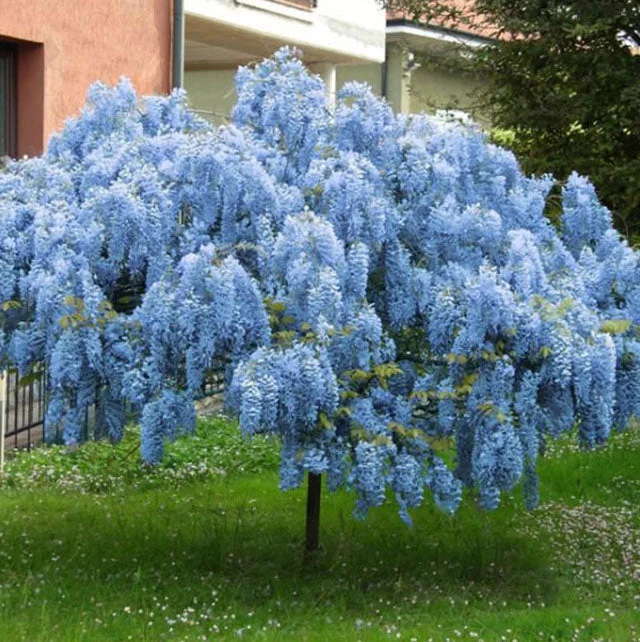
The Blue Chinese blooms once, in spring, on old wood. Its racemes open almost simultaneously, which is why the display reads as one dramatic event rather than a slow trickle. Illinois Extension places bloom in May. In our rows the flowers arrive well ahead of a full canopy of leaves, so the blue-violet shows against bare wood.
The Kentucky Pattern
The Kentucky wisteria keeps a different order, and its scent is described differently too.
The lilac-purple or blue flowers open in April and May after the leaves emerge but before they fully develop. The species is fragrant, while the Blue Chinese is only mildly fragrant. Limited additional summer bloom may occur. Blue Moon is marketed as reblooming on new growth through summer, so ask any seller what they have actually seen in their own plants.
What That Means for Pruning
Old-wood bloomers punish the wrong cut. Trim a Blue Chinese hard in late winter and you remove the buds that would have opened in spring.
Our pruning guide sets out the timing, and our not blooming guide covers the other usual causes. A plant that flowers on new growth is more forgiving, because a mistimed cut still leaves fresh wood that can carry flowers later in the season.
Short Clusters Beside the Blue Chinese Wisteria Tree's Long Chains
Flower length is the quickest identification aid once a plant has bloomed, and you can check it with a ruler.
Wisteria sinensis carries racemes of 6 to 12 inches. The Kentucky wisteria has drooping racemes up to 6 inches. So the Blue Chinese can carry chains twice as long as the species Blue Moon belongs to, which is a large gap even in a small garden.
What You See From Ten Feet Away
Stand back from the vine and look at the overall shape before you look at the color.
A Blue Chinese in bloom reads as a curtain of blue-violet hanging well below the stems. A Kentucky type reads as shorter, tighter tassels set closer to the foliage. Judge by length and shape rather than hue, because both plants are described as running from blue to purple, and light changes how any wisteria looks across a day.
Leaves Help Too
Before bloom, or in a year with no bloom at all, the leaves give you a second clue.
Blue Chinese leaves are alternate and pinnately compound with 7 to 13 leaflets, each 2 to 4 inches long, according to Virginia Tech's dendrology fact sheet. Count leaflets on a few stems. It will not settle the question alone, but it supports or contradicts what the tag says.
Reading the Label When a Blue Chinese Wisteria Tree Ships
A delivery is a checkpoint, and it takes five minutes. Do it before the plant leaves the box.
We often see the problem arrive in one of two forms: a sleeve with only a common name, or a tag that disagrees with the invoice. The table below shows what each kind of shipment looks like.
| Check | Correct Blue Chinese shipment | Mislabeled or unclear shipment |
|---|---|---|
| Latin name on tag | Wisteria sinensis | Only "Blue Moon" or "blue wisteria" |
| Packing slip | Matches the tag exactly | Names a different plant than the tag |
| Hardiness listed | Zones in the 5 to 8 range | Zone 3 claimed |
| Bloom described | One spring flush | Summer rebloom promised |
What to Do on Arrival
If any row of that table points the wrong way, act the same day.
Photograph the tag, the slip and the pot together. Contact the seller before you unpack further, since a plant left in a box for a week is a harder case to resolve. Do not plant it first and sort out the label afterward. A wisteria in the ground is a commitment of many years.
What a Correct Shipment Feels Like
A correct order is dull in the best way: every piece of paper agrees.
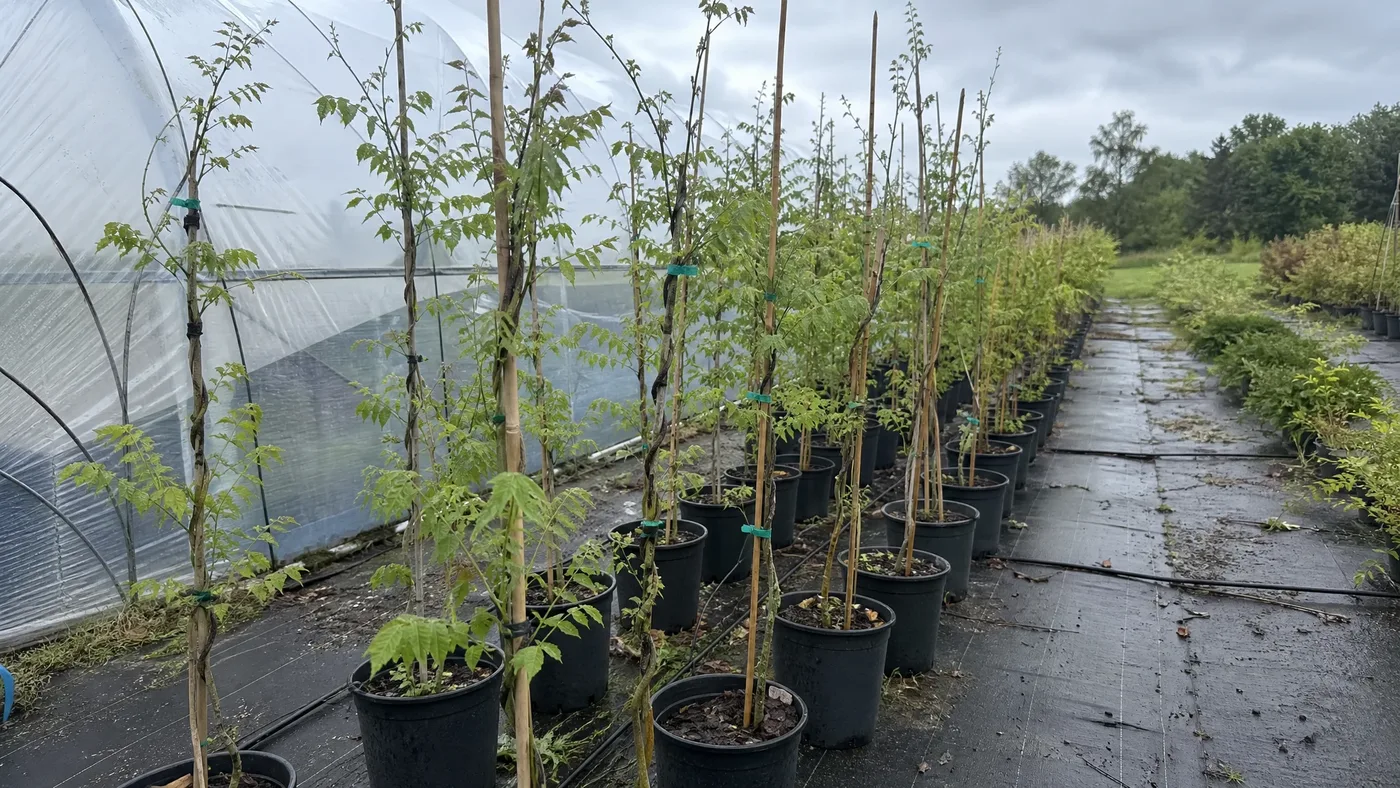
Every Blue Chinese we ship carries Wisteria sinensis on its tag, so the label, the invoice and the plant all say the same thing. Inspect the stems for firm, green tissue, water the root ball if it feels dry, and set the pot in light shade until planting day.
Vigor That Roams, Vigor That Stays Put
Growth habit is where the two plants matter most over several seasons, and where a wrong order is hardest to undo.
Wisteria sinensis is a rapid grower and an invasive weed, and regular pruning is required to control rampant growth and invasive tendency. Alternatives are worth considering. The USDA Forest Service reports it as invasive throughout much of the Eastern U.S. It reaches 10 to 20 feet high and 4 to 30 feet wide.
The Kentucky Contrast
The Kentucky wisteria is a quieter neighbor, according to the same extension service.
It is not as aggressive a spreader as Chinese wisteria, and Blue Moon is not considered invasive. That does not make it maintenance-free, but it does shrink the downside. If invasive risk is your main worry, Blue Moon is the safer choice, and we say so plainly.
Which One We Would Choose
Our answer depends on where you garden and how much work you want.
In zone 3 or 4, or in a region where Chinese wisteria is already a problem, we would choose Blue Moon. In zones 5 to 8, with a sturdy support and a willingness to prune every year, the Blue Chinese gives you the longer chains and the single large spring show. Our invasive roots and control guide explains how to keep it in bounds.
Ordering the Blue Chinese Wisteria Tree You Actually Meant
Here is the sequence we follow, in order, so nothing gets skipped between the cart and the planting hole.
- Confirm the Latin name. It should read Wisteria sinensis, not macrostachya or frutescens.
- Confirm your zone. The Blue Chinese grows in zones 5a through 8b. For anything colder or warmer, check with your local extension service.
- Confirm the bloom habit. One spring flush on old wood means Blue Chinese. A promised summer rebloom points to the other plant.
- Ask about size at shipping. Our buying guide explains what to expect at each size.
- Check again on arrival. Match tag, slip and pot before you plant.
Choosing the Blue Chinese Wisteria Tree on Purpose
The Blue Chinese is a spring-only plant with long chains, a mild scent and a real appetite for space. Blue Moon is a different species, sold for cold hardiness, summer rebloom and a gentler habit. Neither is wrong, but each suits a different yard and a different gardener.
Blue Chinese Wisteria Tree
Nursery-grown Blue Chinese Wisteria Tree in sizes from Quart, shipped to your door.
From $49.49
Shop Now →Before paying, confirm the Latin name, confirm the zone, then confirm the bloom habit. On our farms we grow the Blue Chinese in full sun in deep, moist, well-drained soil with strong support, and as a small business we label every plant by its botanical name so you get the one you ordered.