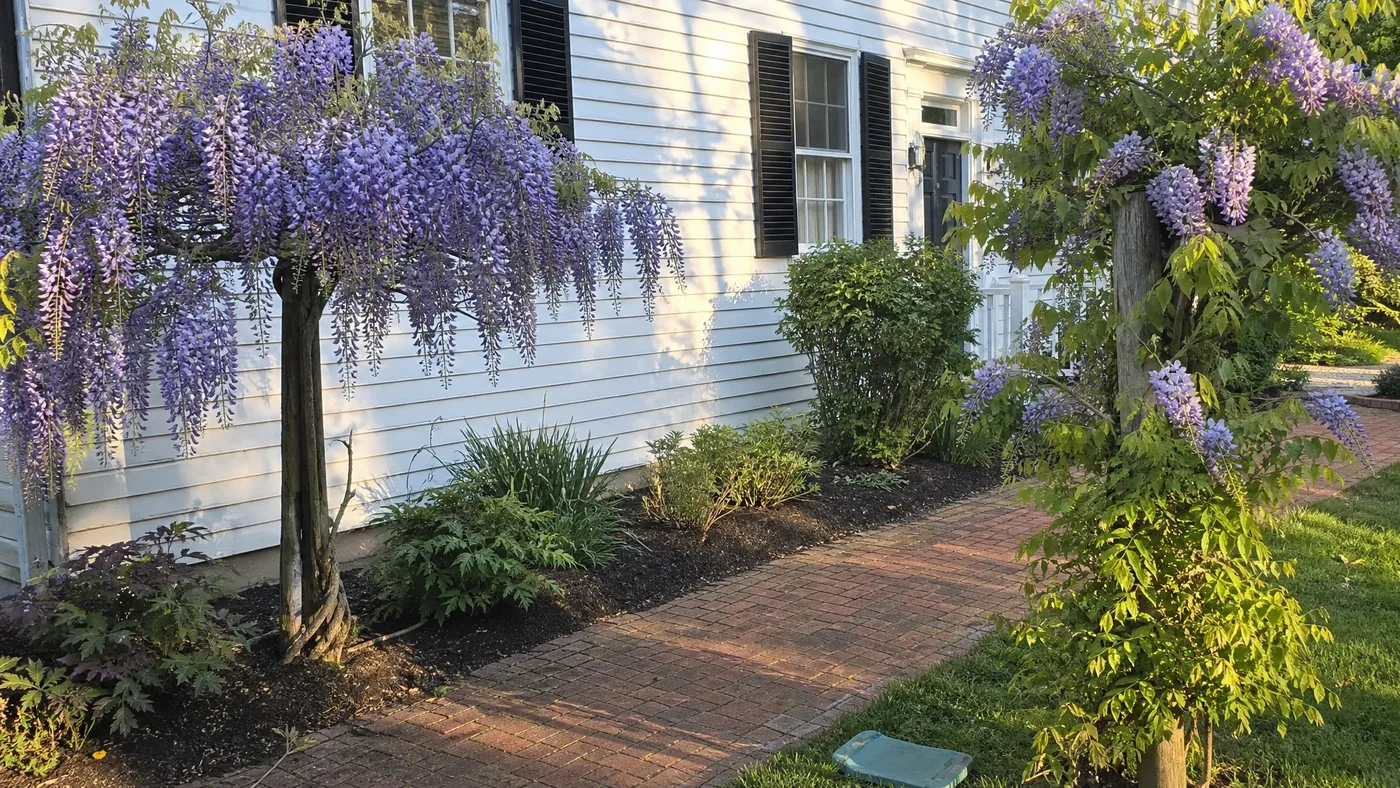
Blue Chinese Wisteria Tree vs Kentucky Wisteria: Hardiness
In January, at dusk, a frozen bud scale looks like nothing at all. Crouch low in a cold yard, press a thumbnail to one, and you are asking a single question: is anything still alive in there? The answer depends on how cold the night got, how hard the wind blew across the stem, and whether cold air settled in that spot.
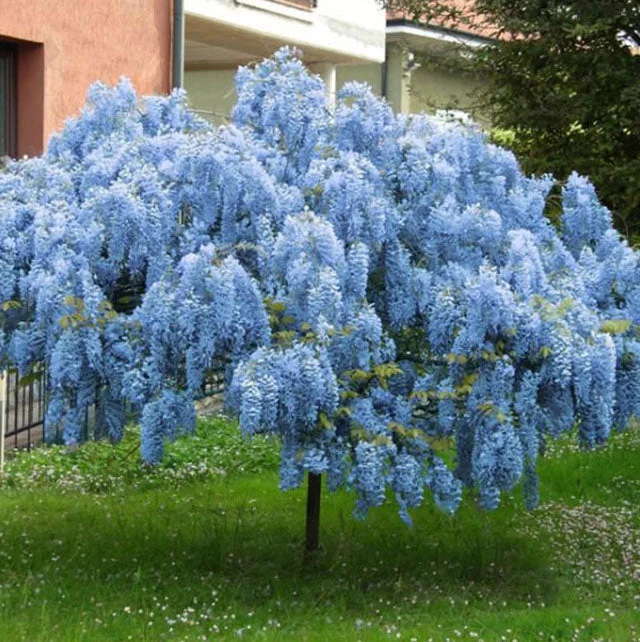
That question sits behind every choice between a Blue Chinese Wisteria Tree and Kentucky Wisteria. The Blue Chinese is reliably hardy to about zone 5. Kentucky Wisteria carries on to zone 4 and flowers on new growth.
Below, you'll find out all about how each one copes with real yards, including a narrow side bed, a windy corner, a hot deck pot and a frost pocket, plus where Kentucky Wisteria grows wild and how to read your own ground.
Narrow Side Bed Between Fence and Foundation
Picture the strip along the side of a house, with a fence on one side and a foundation on the other. The wall throws heat back, the fence stops the wind, and the plant has little room to spread.
Why Shelter Favors the Blue Chinese
Here the Blue Chinese Wisteria Tree earns its place. A bed like this runs warmer than the zone map says, so a yard rated zone 5 can often carry a plant that sits at the edge of its range. The species is hardy in zones 5a through 8b, and the shelter gives you some margin on the cold end.
There is a sensory reward as well. The flowers are mildly fragrant, in 6- to 12-inch racemes. In a narrow passage you walk right past them at nose height, which is the best way to enjoy a scent that is gentle rather than heavy.
The warm wall has a cost. Reflected heat can wake buds early in spring, and a woken bud is a bud that a late frost can reach.
Light and Room in a Tight Strip
Check the light before you check anything else. The plant needs full sun, meaning six or more hours of direct sunlight a day, and a strip shaded by a tall fence or a two-story wall can fall well short of that. A south-facing side bed usually passes the test. A north-facing one usually does not.
The harder question is room. The species reaches 10 to 20 feet in height and 4 to 30 feet in width, and it is a rapid grower that is considered an invasive weed. A strip between fence and foundation leaves a vigorous vine nowhere to go but over the fence.
The Kentucky cultivar 'Blue Moon' reaches about 25 feet and needs proper pruning for the most flowers, so it is no small plant either. Our advice is that a side bed suits the Blue Chinese only if you will prune it on schedule. If you will not, choose Kentucky. Our comparison with Blue Moon covers that cultivar in more detail.
Windy Corner Lot, Blue Chinese Wisteria Tree
Now take the opposite yard: a corner lot where gusts come across open ground all winter. This is the harshest test we can set the Blue Chinese Wisteria Tree, and it fails more often than the zone number would suggest.
What Wind Does to Buds and Stems
Winter wind dries things out. When the soil is frozen, roots cannot replace the water that gusts pull from exposed stems and buds. The Blue Chinese carries next spring's flower buds on its stems through the whole cold season, so every dry gust is a small withdrawal from a bloom you will not see until May.
A plant at the margin of its range suffers most. A Blue Chinese in zone 5 on a sheltered wall may come through easily, while the same plant on an open corner can lose its flowering wood and still leaf out normally. You get a green vine and no bloom.
Why Kentucky Wisteria Shrugs It Off
Kentucky Wisteria blooms on new growth. A tip scorched by wind costs you wood that was going to be replaced anyway, and the flowers form on the shoots that grow after the cold has passed. Add its zone 4 rating and it is the plant we would put on the exposed corner every time.
If you are set on the Blue Chinese here, give it a solid windbreak on the north and west sides first. Plant the vine on the lee side of that screen, not in the open beside it, and water it deeply in late fall if the autumn has been dry. Our guide to hardiness zones and climate needs goes through what the zone range means for site choice.
Blue Chinese Wisteria Tree in a Deck Pot
A container on a hot deck puts the plant through two kinds of stress in one place. Our full advice on growing a Blue Chinese Wisteria Tree in a container is separate, so here we stay with the hardiness side of it.
Why Pot Roots Freeze First
In the ground, soil insulates the roots. In a pot, cold reaches the root mass from every side, including the bottom, and the deck beneath gives no help. Roots are generally less cold tolerant than stems, so a pot can freeze through on a night when the same plant in a bed would be fine.
Treat the zone rating as optimistic for any container. Ask your local extension service how much colder container roots run in your area, and plan to move the pot against the house or into an unheated shelter for the coldest weeks.
Why a Hot Deck Dries the Pot
On a hot deck, a pot heats from the sun on its sides and from the boards under it. Full sun is what the plant wants, and Illinois Extension also describes a vine that needs deep, moist, well-drained soil. A shallow pot dries out faster than the roots can cope with.
We often see potted wisterias that survived January and then scorched in July. Kentucky Wisteria has the tougher constitution for this job, and its flowering on new growth lets it recover from a bad stretch within one season.
If you still want a Blue Chinese on the deck, our plants are sized to settle into a deep container, and a large pot beats a pretty small one.
Frost Pocket at the Bottom of the Yard
Cold air behaves like water. On clear nights it drains downhill and pools in the lowest corner, so the bottom of a sloping yard can sit several degrees below the top. Nothing on the zone map shows this.
Why Flower Buds Lose Here
The Blue Chinese opens its flowers in May according to Illinois Extension, with the buds swelling in the weeks before. A frost at that stage turns a swollen bud brown, and it does not recover. In a frost pocket this can happen spring after spring, so the vine grows well and never flowers.
This matters more because the wait is already long. Seed-raised wisteria can take up to 20 years to flower, and our guide on how many years until a Blue Chinese Wisteria Tree blooms covers what to expect. A plant that waits that long cannot afford to lose bloom years to a cold hollow.
The Plant That Keeps Blooming
Kentucky Wisteria is the clear choice for the pocket. Because it flowers on new growth, a frost that nips early shoots still leaves time for the plant to push more, and the flowers come on that later wood. It also blooms within two to three years, so you are not waiting a decade to find out whether the spot works.
In our rows, the plants that sit lowest in a field are the first to show frost damage, and the pattern is the same in a home yard. Ask which end of your yard stays white longest, and plant the Blue Chinese on higher ground. A wall or dense hedge across the bottom of a slope can trap the cold air, so open a gap for it to drain.
Reading Kentucky Wisteria Against Its Native Range
Step back from the four yards and look at where Kentucky Wisteria (Wisteria macrostachya) grows wild. The comparison is easier once you know what kind of plant you are being offered.
A Native Climber With Neighbors
Kentucky Wisteria is a North American native. For its exact wild range and the plants that grow around it, check your state native plant list or your local extension service, because we will not guess at counties. What we can say is that a native vine has shared its ground with other plants and local insects for a long time, and it behaves like it belongs there.
'Blue Moon' is the hardiest of the wisterias and a recommended alternative to Chinese wisteria, which is on the watch list for potential invasiveness. That fits a plant shaped by real winters. Its zone 4 rating is the evidence we trust more than any story we could tell.
Why Restraint Comes With the Territory
American wisteria, a close relative that lists W. macrostachya as a former name, is not as aggressive a spreader as Chinese wisteria. That page is for a related plant, so we treat it as supporting evidence only. Our guide on whether the Blue Chinese is invasive explains the other side.
The Blue Chinese has its own wildlife notes. It is deer resistant, and its pea-shaped blue-violet flowers open nearly all at once, which makes a short, dramatic feast for whatever insects are out in May. Watch your own plant at midday in bloom and see who visits. We would rather you observe than take our word for it.
Hardiness Is Local to Each Blue Chinese Wisteria Tree
The four yards share one lesson. A hardiness zone is an average winter low across a wide area, and your yard is a small piece of it with its own rules.
A Plain Rule for Choosing
Customers usually ask us which zone number to trust. Our answer is to trust your own yard more. NC State lists the Blue Chinese at zones 5a through 8b, and Illinois Extension gives zones 6 to 8, so the sources already disagree at the cold edge. We say about zone 5 and treat that as a limit, not a promise.
So here is how we would choose. In zones 6 to 8, on a sheltered spot with room and a pruning habit, we would grow the Blue Chinese for its blue-violet flowers and scent. In zone 4, on an exposed corner, in a frost pocket or in a pot, we would choose Kentucky Wisteria and not look back.
What to Check Before You Buy
These checks take one cold weekend and cost nothing.
- Note which side of the house the wind hits and whether a fence or building breaks it.
- Find the lowest point of the yard, where cold air will settle on a clear night.
- Look for walls that reflect heat and wake buds early in spring.
- Count the hours of direct sun the spot gets, since the Blue Chinese wants six or more.
- Decide whether the vine will live in the ground or in a pot.
What the Blue Chinese Wisteria Tree Asks of Your Yard
The Blue Chinese Wisteria Tree wants shelter, room and a mild enough winter, and it pays back with scented blue-violet flowers in May. Kentucky Wisteria asks less of the yard, blooms sooner, and keeps flowering where cold air and wind make the Blue Chinese a gamble. Pick by the yard in front of you, not by the zone on the tag.
Blue Chinese Wisteria Tree
Nursery-grown Blue Chinese Wisteria Tree in sizes from Quart, shipped to your door.
From $49.49
Shop Now →On the next cold morning, walk the yard before the sun is up and note where frost lingers and where it never lands. Then choose the plant. Customers come back to us for the Blue Chinese because that May bloom is worth the right spot, and we are a small business with our own farms, growing top-quality plants and telling you honestly when another one suits your ground better.