What Does a Blue Chinese Wisteria Tree Symbolize?
Picture a scroll painting of wisteria trailing over a scholar's garden wall, the flower clusters hanging in a long blue-violet fringe. Ask what the painter meant by it and the answer has two halves, a feeling and a fact. The feeling is devotion. The fact is that the vine in the painting clings, twists and outlasts the wall it grows on.
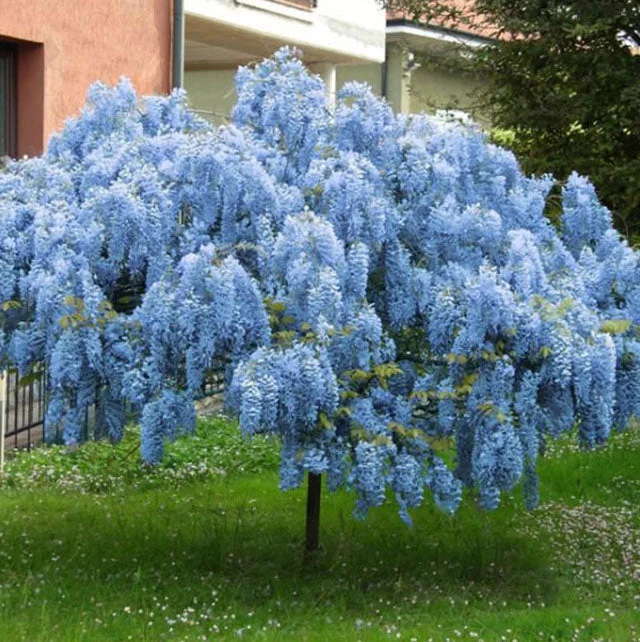
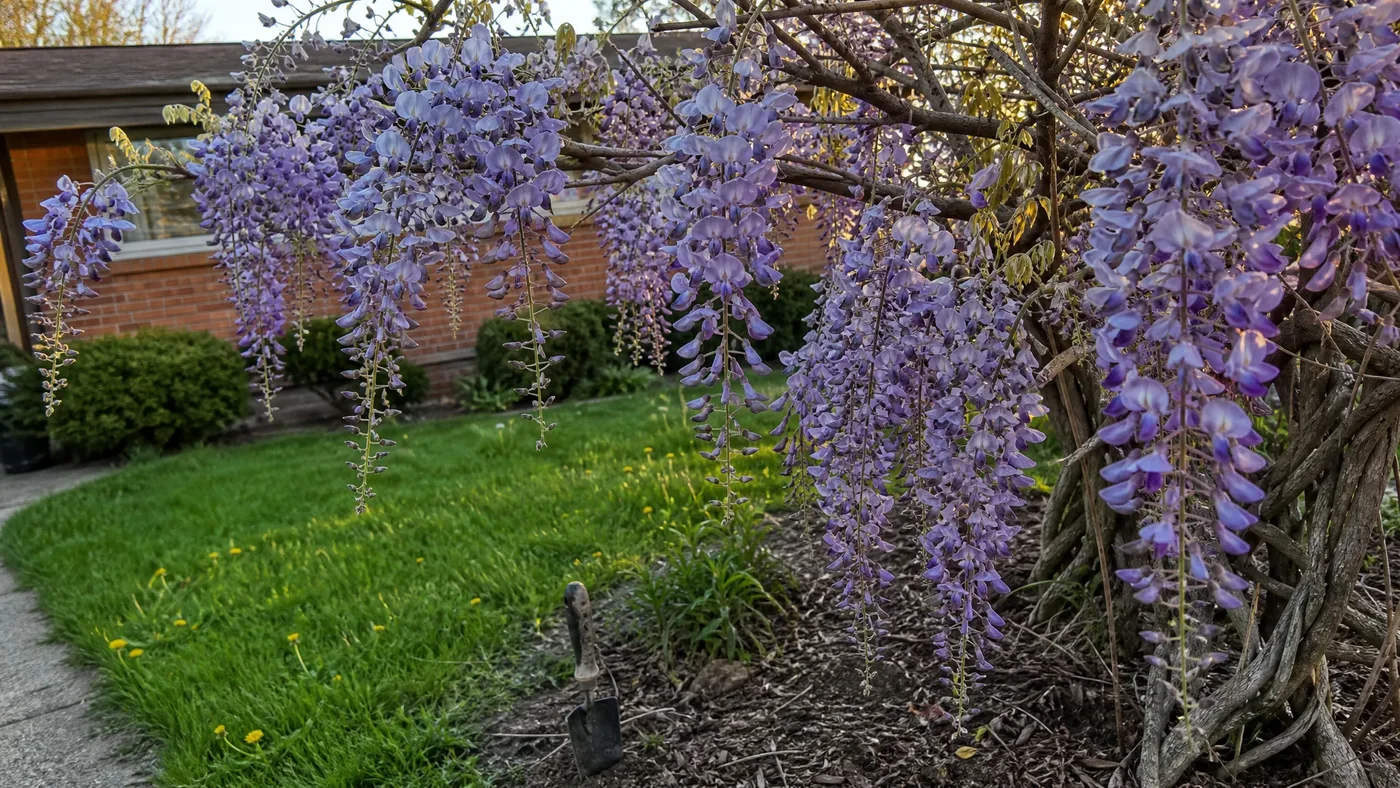
That fact is why the symbol has lasted. Every meaning people have given Wisteria sinensis traces back to something the plant really does. Its racemes (the hanging flower clusters) run 6 to 12 inches long and open almost together. Its stems wind around whatever they find. It takes years to flower, then keeps going for decades.
This guide covers everything you need to know about what the Blue Chinese Wisteria Tree symbolizes, from its place in Chinese and Japanese art to Victorian bouquets, and then to what those meanings tell you about roots, patience and soil in your own yard.
Why the Blue Chinese Wisteria Tree Became a Symbol of Devotion
Two meanings dominate East Asian art and poetry whenever wisteria appears: devotion and endurance. Both come from watching how the plant behaves, which is a large part of why they have lasted.
Devotion in the Twining Stem
Devotion is the reading most people mean when they search for the meaning of wisteria in Chinese culture.
Chinese wisteria is native to China, so the vine painted over a scholar's wall was most likely this species or a near relative. It climbs by twining, which means the stem itself circles a support and tightens as it grows, rather than gripping with tendrils.
This species twines counterclockwise. A painter watching that saw a plant that does not let go, and the step to loyalty between friends, partners or a student and teacher is a short one.
We cannot point you to one founding poem or painting, and we would be wary of anyone who claims to. The meaning built up gradually, as many artists looked at the same behavior.
Endurance in a Long-Lived Vine
The second meaning rests on lifespan, and here the numbers are on the symbol's side.
The species is a large, long-lived climber and takes 10 to 20 years to reach maturity. A plant that outlasts the wall, the garden and the person who planted it is an obvious emblem of endurance. Add the yearly cycle of bare winter stems followed by a spring bloom, and renewal enters the picture as well.
Notice that both meanings are really descriptions of mechanisms: clinging and longevity. Keep that in mind, because the later sections turn each mechanism into a growing decision.
Wisteria in Japanese Family Crests and Chinese Gardens
The two cultures that gave wisteria its meaning used it differently. Japan put it on family crests, while China planted it in gardens and painted it on scrolls.
The Japanese Crest Tradition
Japanese families have long used small circular emblems, called mon, to mark a household, and wisteria is among the best-known designs. The usual image is a ring of hanging clusters, which carries the same ideas of attachment and staying power into something a family could pass down.
One point of accuracy matters here. Japanese wisteria is native to Japan and twines clockwise, the opposite of ours. So the crest tradition grew up around a close cousin rather than this species. We say so plainly because the two are often blended together in symbolism articles.
Where Chinese Gardens Use It
In Chinese gardens and painting, wisteria is a climber for walls, courtyards and framed openings, the kind of place where a scholar sits and looks at a long hanging bloom. This is where our species belongs. Its blue-violet flowers and its native range both point to China.
One of the most common questions we get is whether the wisteria on Japanese crests is the same plant we grow. It is a relative, not the same species, and our guide to the differences between Chinese and Japanese wisteria sorts out how to tell them apart. If you want the Chinese-garden meaning specifically, the Chinese species is the honest choice.
How Victorians Read a Blue Chinese Wisteria Tree in a Bouquet
The Victorian language of flowers gave every bloom a message. Wisteria's message came from its shape and color more than from any record of the plant in the wild.
What the Dictionaries Said
Flower dictionaries of that era disagree with each other constantly, so we treat any single official meaning with caution. The reading most often repeated for wisteria is clinging attachment, something like "I cling to you."
It is the Asian devotion theme arriving in a drawing room, expressed in a form a sender could hand over. Whatever the exact wording in a given dictionary, the clinging idea is the thread that runs through them.
Why a Trailing Raceme Suited Them
The reasons the reading fit are physical. A raceme hangs and droops, which looks like a bowed head, a gesture of tenderness rather than display. The color is blue-violet, a cool and quiet shade that suited feelings that were meant to be understood but not shouted.
The scent matters too. The flowers are mildly fragrant, which means you notice it when you lean in rather than from across the room. That is an intimate quality, and it fits a message passed between two people.
If you grow the plant, you will experience the same thing in May, when the clusters open almost at once and the scent gathers under the vine. Bees and other pollinators tend to find it then, so the bloom is as busy as it is quiet.
The Plant That Crossed the Ocean to Western Gardens
For most of its history the plant belonged to China. Its path west ran through trade, and the botanical name still records where it came from, since sinensis simply means "of China."
Accounts of the first plants to arrive differ in their dates and names, so we leave those details to botanical histories rather than repeat something we cannot source. What is well documented is how far the plant went afterward.
A Chinese wisteria planted in 1892 in Sierra Madre, California is reportedly the largest blossoming plant in cultivation, producing around 1.5 million inflorescences each year. An inflorescence is the whole flower cluster, so that is 1.5 million of the hanging racemes on one vine.
The ocean crossing also changed the meaning. In China the clinging was admired. In North America the same habit has a second reading, because the same extension source warns that established wisteria can persist for years, strangling native trees and shrubs.
The plant goes further still and counts as an invasive weed. Devotion, it turns out, is a quality you want in a partner and think twice about in a vine near your oak.
That is not a reason to avoid the plant. It is a reason to choose its place deliberately, and our guide to whether Blue Chinese wisteria is invasive covers how to keep it where you put it.
Clinging Stems and Blue Chinese Wisteria Tree Roots
Clinging is a metaphor, but it is also a cause-and-effect chain. What the stems do above ground determines what you must provide below it and around it.
Why a Support Has to Be Real
A twining stem starts thin and becomes woody. As it thickens it tightens around its support, which is the same behavior behind the "strangling" warning above. NC State gives the plant's mature size as 10 to 20 feet high and 4 to 30 feet wide, and Illinois Extension lists 20 to 25 feet in height.
A structure that holds a young plant will not necessarily survive a decade of woody growth. Build the support before the plant outgrows it, and tie new growth in the direction it wants to twist, which for this species is counterclockwise. Our guide to staking and support goes through materials and spacing.
What the Roots Are Doing Meanwhile
The sources we rely on do not give root depth or spread figures, so we will not invent them, and we suggest asking your local extension service about your soil type. What they do agree on is that an established plant is hard to remove, and Illinois Extension asks for deep soil.
Deep soil is a clue: this is a plant that anchors itself and keeps going back to the same ground year after year. The lesson is that clinging above implies commitment below. Pick the spot as though you will not move the plant, because once it is established you effectively cannot.
Patience in the Bloom Calendar
Patience is the third meaning people attach to wisteria, and it is the one growers feel most directly. The symbol and the calendar line up closely.
How Long the Wait Really Is
Flowers may not be produced until the second or third year after planting, and sometimes much longer. Illinois Extension lists the bloom in May. So the pattern is a long wait, then a single concentrated show, because the racemes open almost simultaneously rather than trickling out over weeks.
We often see customers worry in year two or three that something is wrong. Usually it is not. Our guide to how many years until a Blue Chinese wisteria blooms covers the range in more detail.
Conditions That Decide the Timing
Age is only one factor. Whether the plant flowers once it is old enough depends on what you give it. These are the points we check first:
- Light: the vine wants full sun, meaning 6 or more hours of direct sunlight a day, and a shadier site tends to produce leaves instead of flowers.
- Feeding: heavy nitrogen pushes leafy growth, so a plant fed like a lawn may grow vigorously and stay bare of blooms.
- Stress and disturbance: a plant that was moved or cut back hard has to rebuild before it can flower again.
The cause is a trade-off inside the plant. Energy goes to either growth or flowers, and the conditions above tilt that balance. Patience in this sense is not passive. It means removing the things that delay the show.
Well-Drained Ground Behind Your Blue Chinese Wisteria Tree
Every meaning in this guide assumes a plant that survives long enough to live up to it. Drainage is where that either happens or does not.
What Well-Drained Actually Means
Illinois Extension says the vine needs a deep, moist, well drained soil. Moist and well drained sound contradictory, but they are not. Soil holds water in its small pores while excess water moves through and out, which leaves air in the larger spaces.
Roots need that air. In soil that stays saturated, they are starved of oxygen no matter how much water is present.
The vine tolerates acid, neutral and alkaline soil, with neutral meaning pH 6.0 to 8.0, so pH is rarely the limiting factor. Texture and drainage usually are. Our guide to choosing the best soil covers how to amend heavy ground.
Matching Each Meaning to a Practice
The table below ties each symbolic reading to the growing decision it implies.
| Meaning | What it asks of you |
|---|---|
| Devotion | A permanent site, chosen before planting, in full sun |
| Endurance | Deep soil that drains, so the roots survive for decades |
| Patience | Moderate feeding and no repeated disturbance |
| Clinging | A sturdy support built for a woody vine |
To test drainage, dig a hole where the plant will go, fill it with water, and watch how the water leaves. If it is still standing long afterward, the site needs improvement or a different location. Your local extension service can advise on what works in your soil.
Check Drainage for Your Blue Chinese Wisteria Tree
Devotion, endurance and patience are good descriptions of this plant, and each one is earned by something it does. A symbol only holds up when the ground under it is sound, so check your drainage this season, before the next bloom depends on it.
Blue Chinese Wisteria Tree
Nursery-grown Blue Chinese Wisteria Tree in sizes from Quart, shipped to your door.
From $49.49
Shop Now →As a small grower, we handle every vine from our own farms to your yard, and the failures we hear about nearly always trace back to wet ground rather than the plant. Getting the soil conversation right is how our top-quality wisteria gets to live out the meanings people have given it for centuries.